Mistaken for Normal: Why Early Hair Loss Is So Frequently Overlooked—And the Clinical Cost of That Delay
For many patients, the journey toward effective hair loss treatment doesn't begin at a dermatologist's office. It begins at a bathroom drain, a hairbrush, or a well-lit mirror on an unexpectedly honest morning. And yet, even when that moment of recognition arrives, the most common response is not urgency—it's rationalization. "I've always shed a lot." "It's just stress." "It runs in my family, but I'm probably fine."
This instinct toward minimization is not irrational. It is, in fact, encouraged by a widespread cultural assumption that hair shedding is inherently normal—and it is, to a point. The clinical problem emerges when normal and pathological overlap in ways that are genuinely difficult for untrained observers to distinguish. By the time the difference becomes undeniable, months or years of viable treatment opportunity have often already passed.
The Biology of Normal Hair Shedding: What the Numbers Actually Mean
The human scalp houses approximately 100,000 individual hair follicles, each cycling independently through phases of growth (anagen), transition (catagen), and rest (telogen). Under typical conditions, roughly 85 to 90 percent of follicles are in active growth at any given time, with the remainder in transition or resting phases. The natural result of this cycling is a daily shed of approximately 50 to 100 hairs—a figure cited so frequently in patient-facing literature that it has become the informal benchmark most people use to self-assess.
The challenge is that this number is an average derived from population data, not a precise threshold that cleanly separates health from disease. Individual variation is substantial. A patient with naturally dense hair may shed 120 hairs daily and remain well within normal parameters. A patient with finer hair may begin experiencing clinically meaningful follicular miniaturization at 80 hairs per day. Raw shed count, in isolation, is a poor diagnostic instrument.
Why Androgenetic Alopecia Hides in Plain Sight
Androgenetic alopecia—the most prevalent form of hair loss in American men, affecting an estimated 50 million individuals—progresses through a mechanism that is particularly well-suited to evasion. The condition does not begin with dramatic, sudden loss. It begins with follicular miniaturization: a gradual process in which genetically susceptible follicles, sensitized to dihydrotestosterone (DHT), produce progressively thinner, shorter, and less pigmented hairs over successive growth cycles.
This miniaturization can be underway for two to four years before a patient notices any visible change in hair density. By the time thinning becomes apparent to the naked eye—particularly under standard indoor lighting—the follicular landscape has often already shifted considerably. The hairs being shed are not simply falling out; they are being replaced by hairs of diminishing caliber, a process that eventually culminates in follicular dormancy.
Because each individual shed hair may look similar to what a patient has always shed, the early warning signs are effectively invisible to casual observation. What changes is not the quantity of shedding so much as the quality and diameter of the hairs being produced—a distinction that requires clinical tools, not a bathroom mirror, to detect reliably.
The Diagnostic Gap Between Self-Assessment and Clinical Evaluation
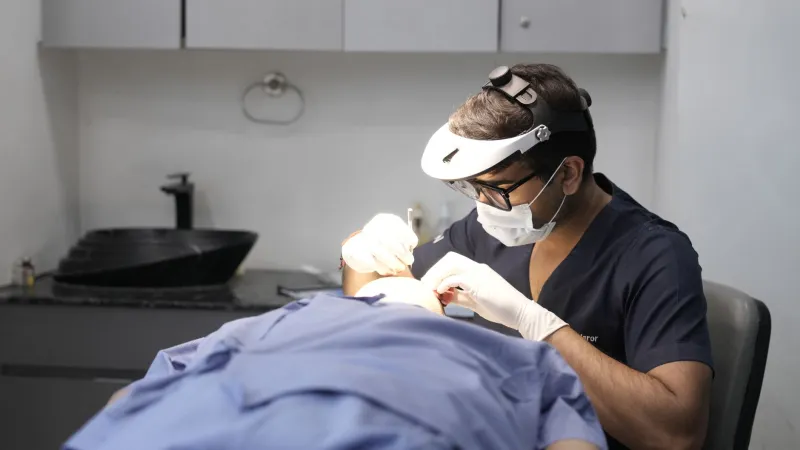
Dermatologists and trichologists have access to several diagnostic modalities that patients simply do not. Dermoscopy allows a trained clinician to visualize follicular miniaturization, perifollicular pigmentation changes, and hair shaft diameter variability at a level of magnification that transforms the scalp into a readable clinical document. Trichoscopy, a specialized application of the same technology, can identify early-stage androgenetic alopecia years before it becomes apparent to the patient.
The pull test—a simple, in-office procedure in which a clinician gently grasps approximately 60 hairs and applies traction—can help differentiate active shedding disorders such as telogen effluvium from the more insidious pattern of androgenetic alopecia. Blood panels assessing thyroid function, ferritin levels, and hormonal markers can rule out systemic contributors that mimic or exacerbate genetic hair loss.
None of these tools are available to a patient conducting a self-evaluation. Yet many patients never reach a provider's office precisely because their symptoms do not feel dramatic enough to warrant a visit. This is the diagnostic gap that costs patients years.
Telogen Effluvium vs. Androgenetic Alopecia: A Clinically Significant Distinction
One of the most consequential misidentifications in hair loss medicine is the confusion between telogen effluvium—a temporary, diffuse shedding episode triggered by physiological stress, illness, nutritional deficiency, or hormonal shifts—and the early stages of androgenetic alopecia.
Telogen effluvium typically presents two to four months after a triggering event, produces noticeable increases in shed volume across the entire scalp, and resolves on its own once the underlying cause is addressed. Androgenetic alopecia, by contrast, follows a patterned distribution (most commonly the crown and frontal hairline in men), progresses slowly but continuously, and does not resolve without intervention.
The problem is that both conditions can present simultaneously, and early androgenetic alopecia can be masked by the dramatic shedding of a concurrent telogen effluvium episode. When the effluvium resolves and shedding normalizes, patients frequently conclude that the episode was the entire story—not recognizing that the patterned, miniaturization-driven loss continues quietly beneath the surface.
What Early Intervention Actually Means for Long-Term Outcomes
The clinical rationale for early treatment is grounded in follicular biology. Once a follicle has undergone complete miniaturization and entered a prolonged dormant state, the probability of meaningful regrowth with current therapies declines substantially. Finasteride, the only oral medication FDA-approved for male pattern hair loss, operates by inhibiting the conversion of testosterone to DHT—a mechanism that is most effective when follicles retain enough structural integrity to respond.
Large-scale clinical studies have consistently demonstrated that patients who initiate treatment during early-stage loss achieve superior outcomes compared to those who begin treatment after significant thinning has occurred. Early intervention is not merely about preserving cosmetic appearance; it is about preserving the biological substrate on which treatment depends.
Every month of untreated progression represents follicular change that cannot be fully reversed. The window for optimal treatment response is not indefinite.
How to Advocate for Proper Evaluation
Patients who suspect early-stage hair loss often encounter a frustrating clinical reality: primary care physicians, while invaluable for general health management, are not always equipped to conduct specialized hair loss evaluations. A routine annual physical is unlikely to include trichoscopic assessment or detailed scalp examination unless the patient explicitly raises the concern and requests a referral.
Several practical steps can improve the likelihood of receiving appropriate evaluation:
- Document your shedding systematically. Photograph your scalp under consistent lighting conditions (ideally using a parting along the crown) every four to six weeks. This longitudinal record is far more informative than a single-point observation.
- Request a dermatology referral early. Do not wait until thinning is dramatic. Frame the conversation with your primary care provider around family history and early detection rather than crisis management.
- Ask specifically about trichoscopy. Not all dermatology practices offer this tool, but those that do can provide diagnostic clarity that standard examination cannot.
- Bring a complete medical history. Thyroid conditions, iron deficiency, recent illness, and significant psychological stress are all clinically relevant to accurate differential diagnosis.
The Takeaway: Uncertainty Is Not a Reason to Wait
The most persistent obstacle to early hair loss treatment is not denial—it is uncertainty. Patients are not sure whether what they are experiencing is meaningful, and in the absence of certainty, inaction feels like the reasonable default. Clinically speaking, however, inaction during a period of active follicular miniaturization is itself a consequential choice.
If you have noticed changes in your hair density, texture, or distribution pattern—even subtle ones—the appropriate response is not to wait for the evidence to become undeniable. It is to pursue evaluation from a qualified clinician who can distinguish between what is transient and what requires attention. The cost of a dermatology appointment is modest. The cost of a delayed diagnosis, measured in follicular capital that cannot be recovered, is considerably higher.